
Manufacturing Process Assurance
The high-voltage coils are wound using a high-speed winding machine that applies constant mechanical tension to the conductor. A servo system enables stepless, automatic wire-laying control, ensuring tight, compact winding and accurate automatic counting. Because the conductor is kept taut and pressed firmly during the winding process, the coil turns are tightly packed; the contact with the end insulation is rigid and leaves no margin for compression-a principle that applies equally to the low-voltage coils. Consequently, the axial height of the wound phase assembly consistently meets design specifications, thereby ensuring the accuracy of the impedance voltage.
Core Stacking
The core is assembled on a pneumatic tilting stacking table using specialized positioning tooling and a stacking process that excludes the top yoke. After the core is stacked and the bottom clamp is secured, the core limbs are temporarily clamped using channel steel and the top clamp, with C-clamps providing additional spatial support. The assembly is then tilted upright and moved to a storage area for the application and curing of a fixing agent; once cured, the temporary clamps are removed, and the unit proceeds to the active part assembly stage. The resulting core features firm interlaminar bonding, low losses, and low noise levels.
Active Part Assembly
As the core is assembled without the top yoke, the windings form distinct phase units. Molded epoxy resin blocks are used for the yoke spacers, while high-voltage and tap leads are insulated using reinforced PVC tubing and other specialized components. Insulation and lead assembly take place on a rolling platform production line, ensuring rapid assembly, high quality, and a clean working environment.
Corrugated Tank
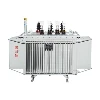
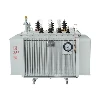
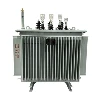
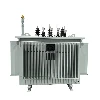
The corrugated tank is manufactured using a folding machine within the corrugation production line. This machine automatically folds cold-rolled steel sheet coils into the specific profiles required by the design drawings, including parameters such as corrugation height, pitch, straight-edge length, and overall dimensions (length and width). The folding process is high-quality and efficient; after folding, the corrugated fins proceed to the welding stage, where the folded end seams and reinforcing bars are welded. Argon arc welding is employed, ensuring a stable arc, deep weld penetration, and a defect-free, well-formed finish. The corrugated oil tank consists of a base and a rim, with a rectangular body formed by welding together an assembly of corrugated fins. These fins are fabricated by folding thin sheet metal; in addition to providing excellent heat dissipation during transformer operation, the corrugations allow for expansion to alleviate internal pressure buildup.
Features
10kV and 35kV class S9, S10, and S11 series distribution transformers, with capacities ranging from 30 to 3150 kVA. The core features a three-phase, three-limb, multi-step cylindrical design. The coils utilize a simultaneous winding technique, ensuring excellent concentricity and high short-circuit withstand capability; key technical specifications meet advanced domestic standards for similar products.