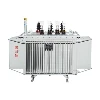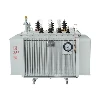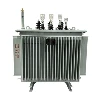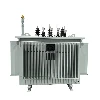

As a core component of power transformers, the coil features a highly complex structure. It is primarily constructed by meticulously winding copper (or aluminum) conductors and incorporating specialized insulation materials to ensure safe and reliable operation.
1. Helical Coil
Helical coils play a pivotal role in power transformers due to their unique construction and superior performance. They are characterized by the use of numerous parallel conductors wound into a helical shape, where each coil disc constitutes a single turn. This design not only provides excellent mechanical stability and heat dissipation but also enhances manufacturability. Consequently, helical coils are widely used in low-voltage, high-current transformer applications.
Furthermore, depending on specific current requirements, helical coils can be precisely wound into single-helical, double-helical, or quadruple-helical configurations to meet diverse operational needs.
2. Continuous Coil
Continuous coils consist of multiple coil sections distributed sequentially along the axial direction; these sections form a complete coil without the need for inter-section welding. They feature broad end-support surfaces, enabling them to withstand significant axial forces and offering robust resistance to short-circuit stresses. Additionally, the excellent heat dissipation capabilities of each section make this type of coil suitable for a wide range of voltage levels and power capacities.
3. Interleaved Coil
Interleaved coils are formed by connecting multiple interleaved sections (or discs). A coil composed entirely of interleaved sections is known as a "fully interleaved coil," a design widely used in transformers rated at 220 kV and above. Conversely, a coil combining interleaved sections with continuous sections is termed an "interleaved-continuous coil," a configuration utilized in transformers rated at 66 kV and above.
By ingeniously inserting non-adjacent turns between adjacent ones, the interleaved coil creates a unique, interlaced structure. This design not only increases the coil's longitudinal capacitance but also effectively improves the distribution of impulse voltage along the axial height of the coil. For this reason, interleaved coils play a pivotal role in high-voltage coil applications.
4. Internally Shielded Coils
The design principle of the internally shielded continuous-disc coil is to optimize impulse voltage distribution by increasing the series capacitance between coil sections. Its unique feature lies in the inclusion of additional capacitive turns wound directly within the continuous-disc sections; the ends of these turns are insulated and left floating within the section. Notably, these capacitive turns do not carry load current; they function solely under the influence of impulse voltage. Furthermore, internally shielded continuous-disc coils offer various structural configurations-such as two-section, four-section, and eight-section crossovers, as well as sectional connections-to meet diverse application requirements.