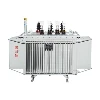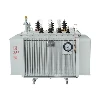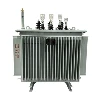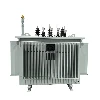

Under normal environmental conditions, distribution transformers should be installed on poles or on ground-level outdoor platforms. For factories, workshops, and suburban residential areas, distribution transformers may be installed indoors, depending on specific circumstances.
Components and Characteristics of Pole-Mounted and Ground-Mounted Outdoor Installations
Pole-mounted Installation
(1) Single-pole
The transformer, high-voltage drop-out fuse, and high-voltage lightning arrester are mounted on a single utility pole. This configuration features a simple structure, ease of installation, and minimal material and land usage; it is suitable for distribution transformers rated below 50 kVA.
(2) Double-pole
Consists of a terminal pole for the high-voltage line and a secondary pole (approximately 7.5 m in length). It is more robust than the single-pole configuration and can accommodate distribution transformers rated between 63 kVA and 315 kVA.
Ground-mounted outdoor installation: The transformer is placed directly on a masonry platform (or pier) with a height of at least 2.5 m. This allows for convenient installation and removal, and there are no restrictions on transformer capacity.
Safety and Technical Requirements for Distribution Transformer Installation
1. Safety and technical requirements for pole-mounted distribution transformers
(1) The transformer base must be at least 2.5 m above the ground, and all metal components must be grounded.
(2) Exposed live parts must be at a height of more than 3.5 m above the ground.
(3) The transformer base must be secured to the mounting platform, and the upper section must be fastened to the pole using appropriate hardware.
(4) Both the upper and lower transformer leads must be made of stranded insulated wire. The high-voltage drop-out fuse must be at least 4 m above the ground, and the spacing between the center phase and outer phases of the high-voltage fuses must be at least 0.5 m. The angle between the centerline of the high-voltage fuse's porcelain component and the vertical line should be between 25° and 30°.
(5) A warning sign reading "No Climbing – High Voltage Danger!" must be displayed.
2. Safety and technical requirements for outdoor ground-mounted distribution transformers
⑴ The foundation of a ground-mounted transformer must be raised at least 0.2 m above ground level; in areas prone to water accumulation, drainage channels should be constructed around the transformer. A masonry enclosure (brick or stone wall) at least 1.8 m high must be built around the transformer; the gate must be made of fire-resistant material, located on the low-voltage side, designed to open outwards, and equipped with a lock. Bamboo or wooden fences are not suitable.
⑵ For transformers installed on platforms or pedestals, the height of the platform or pedestal must be at least 2.5 m.
⑶ When two or more transformers are installed outdoors, the clearance distance between their casings must be at least 1.25 m.
⑷ The transformer casing must be properly grounded.
⑸ The distance from the transformer to combustible buildings must be at least 5 m, and the distance to fire-resistant buildings must be at least 3 m.
⑹ Warning signs reading "Stop! High Voltage Danger" must be displayed on the enclosure wall or the platform/pedestal.
3. Safety and technical requirements for indoor distribution transformers
⑴ The indoor area must have good natural ventilation.
⑵ The transformer room must meet the Class I fire-resistance rating.
⑶ The clear distance from the transformer casing to the rear and side walls must be at least 0.6 m, and the clear distance to the door must be at least 0.8 m; doors and windows of the transformer room must open outwards, and louvers must be installed at the bottom of the doors and windows.